Showing posts sorted by date for query saving heritage. Sort by relevance Show all posts

September 02, 2011

Saving Our Heritage | Travel To The Past - Candi Exploration

0 Comments
When I go places, I find something to do.
Lebaran Holiday had arrived at our front door, and the family decided to go for a trip to our Dad's homeland. I figured, it's been so many times that I visited this land, at least once a year. What more could I do at this place. It all started with me trying to take pictures of sunrise/sunset from Borobudur Temple. I always see this sugoi pictures at google image when you keyed in "borobudur", and always wonder, how did they get that? So one afternoon after celebrating Hari Raya with the family, I tapped my dad on the shoulder. "Dad, let's go visit Borobudur Temple this afternoon". I packed my bro's DSLR camera *btdub, still a newbie at this*, and hopped on to the SUV. 
We decided to go from Klaten to Magelang through the road less traveled. And finally getting passed the Jumoyo Village at least what's left of it. A village right on the banks of Kali Putih. The one flooded with cold lava during Merapi eruption last year. Arriving at Borobudur, I just can't help but to love this place. Looking at the site, is like travelling to the past. This was and is a religious site for Buddhist. The site may not be as extravagant as China's Great Wall, but still, in the era when you got no buldozer and any other machinery stuff, you can carve a stone diligently, and then set it up block by block. It's like playing LEGO but in real size. After I got the satisfying pictures for an amateur photographer, I went back to Klaten, and wonder, what more can I get out of this. Then I decided to go for some more picture hunting to cultural sites. As always, I went to Google for some more suggestion. And 5 minutes after, I got a list of recommended small Candi (temple) to visit. I was not interested to visit the big ones or the really famous ones. Because I've been there for too many times. This time, I'd like to visit the never seen by me before. And so the adventure of the cultural heritage begins. 
1. Candi Plaosan 
The first to visit by me would be Candi Plaosan. It is a Buddhism temple located at Bugisan Village, Klaten, Central Java. The temple was located not far from the Prambanan complex. The temple was divided into two sites, Candi Plaosan Lor (North) and Candi Plaosan Kidul (South). The Northern sites have the main temples reconstructed already, with little temples all around it. As for the Southern site no main temples are located yet. Although a Buddhist temple (with almost complete Bodhisatvva statues inside) you'll find the temple has a Hinduism architectural style. When first founded, it is told that the temple was actually filled with bronze statues and ornaments. Where it is now? A Museum in Leiden. *I almost laugh in agony when I heard this* 
2. Candi Kedulan 
I actually told my rented car driver to take me to Candi Barong. But somehow he took me to a Candi site where all the stones are in rumbles. The Candi is still under reconstruction. And only God knows, when the reconstruction of this candi will finisih. I almost thought that it IS Candi Barong. But after I went home, I did some internet investigation, and find out that it is Candi Kedulan. Not much known about this temple yet. Hopefully the reconstruction will be done soon, and we'll find out more of the stories from the past. 
3. Candi Kalasan 
Located at Kalasan, Sleman, Jogjakarta if you travel from Jogja-Solo passed the Jogja-Solo Mainstreet, you'll see this temple right beside the street. Although if you don't pay enough attention it could be a bit hidden by the houses and kiosks surrounding it. Candi Kalasan is also a Buddhist temple. What I love most about this temple is that it's partly ruined. You can see the half reconstructed stupa at the top of temple. It will never be finished as not all the stones are found. And also you can find very fine and detail carving on the stones. In each window you can find a Batara Kala carving. It is said that the Candi Kalasan we see today, is actually a building on top of another Candi built before. The temple was built to worship Tara (a female Bodhisatvva). From several inscriptions, it is believed that the temple was built during Syailendra dynasty's expansion to the land of Java. 
4. Candi Sari  
This temple is located not far from Candi Kalasan. You can say, if Candi Kalasan is on the right side of the mainstreet, then Candi Sari would be on the left side. If you look at the architectural design, you'll find it not much different with Candi Kalasan, therefore it is assumed that the temple is built almost at the same time. Unlike most other temples, this Candi is built 2 stories high. It is believed that this temple was built as a learning centre for the monks. Each chambers were used for monks to meditate. 
5. Candi Sambisari  
The only Hinduism temple I visited the day (that is if Candi Kedulan also proven as Buddhism temple,, :P). What's uniques about this temple is that it doesn't have a foundation like any other. Moreover the site is lower than the surroundings. This temple was found not long ago. It was in 1966 when a farmer was hoeing his paddy field and accidentally hit a carved rock. Studies on the rock was done, and it is believed that the temple was buried down during Merapi eruption in 1006. The main Candi is accompanied by three little temples at the front gate. If you went inside the Candi, you'll see that the two side walls and back wall is guarded by Durga, Ganesha, and Agastya. In the main chamber you'll find Lingga Yoni the symbol of male&female. Well, I guess that's some of the Candi I successfully visited for the day. Sure will come back for more, as there are more to explore. For more pictures you can just click below slideshow. One more thing, you'll also find pictures from Candi Ratu Boko (which is actually more of a palace instead of a temple), view of the infamous Merapi and his sister Merbabu.

Travel to The Past Slideshow: Mayankcat’s trip from Jakarta, Java, Indonesia to 5 cities , Desa Bugisan (near Yogyakarta), Boyolali (near Solo), Desa Jumoyo (near Borobudur) and Magelang was created by TripAdvisor. See another Indonesia slideshow. Take your travel photos and make a slideshow for free.

April 24, 2011

Saving Our Heritage | Indonesia's Kite Museum and The Unfinished Mural

0 Comments
When I first went to Indonesia's Kite Museum last year, I had to be disappointed, because the museum was shut down for a day due to a wedding reception that'd be held there. And thank you for a three days weekend due to Easter Holiday, finally my friends and I got another spare time to visit this museum.
How do I know about this museum is thru Mr Google. And it caught my eye as the museum provides numerous workshops at affordable prices. For 10.000 IDR you will get a packet of watching short movie about kite, a tour to see the collection, plus a small kite making workshop. For an extra 50.000 IDR you can have another workshop to paint t-shirt, ceramic making (but need to pick up the finished ceramic after 1 week, as the ceramic need to go through the burning process first), batik making (min. 5 person), or umbrella painting.
It may be a small museum, but the collection is enormous. I get to see not only traditional kites from each region in Indonesia, but also kites from other countries. And what the kites were made of was also shocking. I always thought that kites are made from paper or thin cloth. But there, I found kites made of Pandan leaves weaving, shapeable Lontar leaves, plastic and others. And the size, you can see kites in 2D or in 3D, hundred meters long and wide, also as small as 5cmx5cm.
What is more amazing is, when I saw the movie, it shows a controllable kite. It can dance, it can walk on the ground, and it can maneuver like the jets on military parades. This all depends on how strong the wind is. For example when the wind is really strong, you can have a three paralel kites maneuvering. But when there's no wind, the kite can only walk on the ground. Not all kite can do this. The ones that can must shape like the kite beside, plus this kite is controlled by two string (unlike most other kites).
For some part in Indonesia (and sometimes other country), kites are not just a toy for the kids. For example in Kalimantan on the wedding reception two kites will be flown by the bride&groom. The groom will flown the Dandang Laki, and the bride will flown the Dandang Bini. Actually this thought kinda freaks me out. I mean, what happens if you can't fly the kite?!?! Will the wedding be off?? :)
Another story, making kite might not cost a lot. But what do cost a lot is the ritual that goes with it. In some part of Indonesia, traditional kites are considered sacred. That's why upon making it there are several rituals and ceremonies that they must do. One more interesting thing, it is never a kite unless it makes a sound when it's flying.
Done having a tour, it's time for a little handicraft, and a walk around the museum for a little photoshoot. :) *trust me this place is filled in with a lot of natural sets that can fulfill your narcissistic personality*

Located at Jl. H. Kamang No. 38, Pondok Labu, South Jakarta, makes Museum Layang-Layang Indonesia pretty secluded from Jakarta's busy street, but still make it easy to reach. For more info, just visit their FB page. A little advice, if you're travelling in large group (>20people) better make a reservation first. And do call the museum before you visit, to make sure whether they're closing down that day for a private party or not.


Next stop we go visit Jakarta's Historical Museum (or the infamous Fatahillah Museum) to see the unfinished Mural Painting by Harijadi Sumodidjojo. The "Batavia Situation between 1880- 1920" mural is an ambitious project started in 1974 to fill a 200m2 wall with paintings. A detail capture to the hustle and bustle of Jakarta's social life at colonial times. It is a complete painting along with the dominating Europeanen, the Vreemde Oosterlingen merchants, and the suppresed inlanders. Although unfinished, the painting still give me the chills when I enter the room. Wonder what it would be like if it was a completed painting. Then again maybe the chills came, because half of the paintings are only sketches.
To spice up the exhibition, before we enter the room of the mural painting. We will see a show by Teater Koma. It is an interactive animated performance, in which characters from the mural painting suddenly came to life, with three additional human players, as narrator and soldiers. The performance itself is actually only the introduction to a story "Mystery of Batavia". This fictional story is inspired by the mural painting. In order to know how the story ends, we must follow the digital comic at www.mysteryofbatavia.com which is updated every Friday.


May 23, 2010

Kerak Telor, Pasar Ikan, & Batavia Punch Story

0 Comments
I've been living in Jakarta ever since I was born, that means been here for almost a quarter century *not going to be 25 till July*. Therefore in order to celebrate my existence in this place called home, I'm determined to explore every inch of this city.blogger-emoticon.blogspot.com
So I've been here and there before, parts of it were featured in my "saving our heritage" stories. Anyway, decided to get in touch with the Betawi (Jakarta native) culture, and the best place to do it would be to visit a genuine Kampung Betawi (Betawi Village). One of it that has been well managed would be a Kampung Betawi located at the side of Setu Babakan (a reservoir). You can reached this village from the Moh Kafi 2 Street, Jagakarsa. And when you see this gate like the ones on the right picture, do not hesitate to head that way. You'll be passing a classic-modern betawi village. Most of the houses still retain the betawi architecture, although some mix and match it with the modern architecture. When you think you got a little bit lost inside the village, don't worry, the resident already know where you are heading. hehe.. You don't even have to ask for direction, just put on a confuse face, they'll automatically point the road to the Setu.
What you'll find here? Well, there are some water activities you can do, such as fishing, canoeing, or paddling the duck boat. They also have a mini plots where they have three to four betawi model homes. And you can take picture there. In it was also a mini stage, where they perform traditional arts such as kromong, tanjidor, lenong, and jaipong. Unfortunately they only do it on Sundays, that's what the caretaker informed us when we asked what show they'll have that day. But what I love most at Setu Babakan is sitting on the side of the lake and eat traditional foods. You name it, they got it. There's kerak telor *yes,, we just discovered the best kerak telor we ever taste, it's served fresh from the fire, but not too hot to eat, it's not too thick, burnt but not hard*, serabi, Bir pletok, dodol betawi, roti buaya, and many more.Then we played soap bubbles just like what we did way back when we were kids. The entrance fee to this site is really cheap. I only got to pay 3000 IDR, that is basically a ticket for bringing in a car *because the caretaker did not count how many people in the car*, and about 2500 IDR for parking.
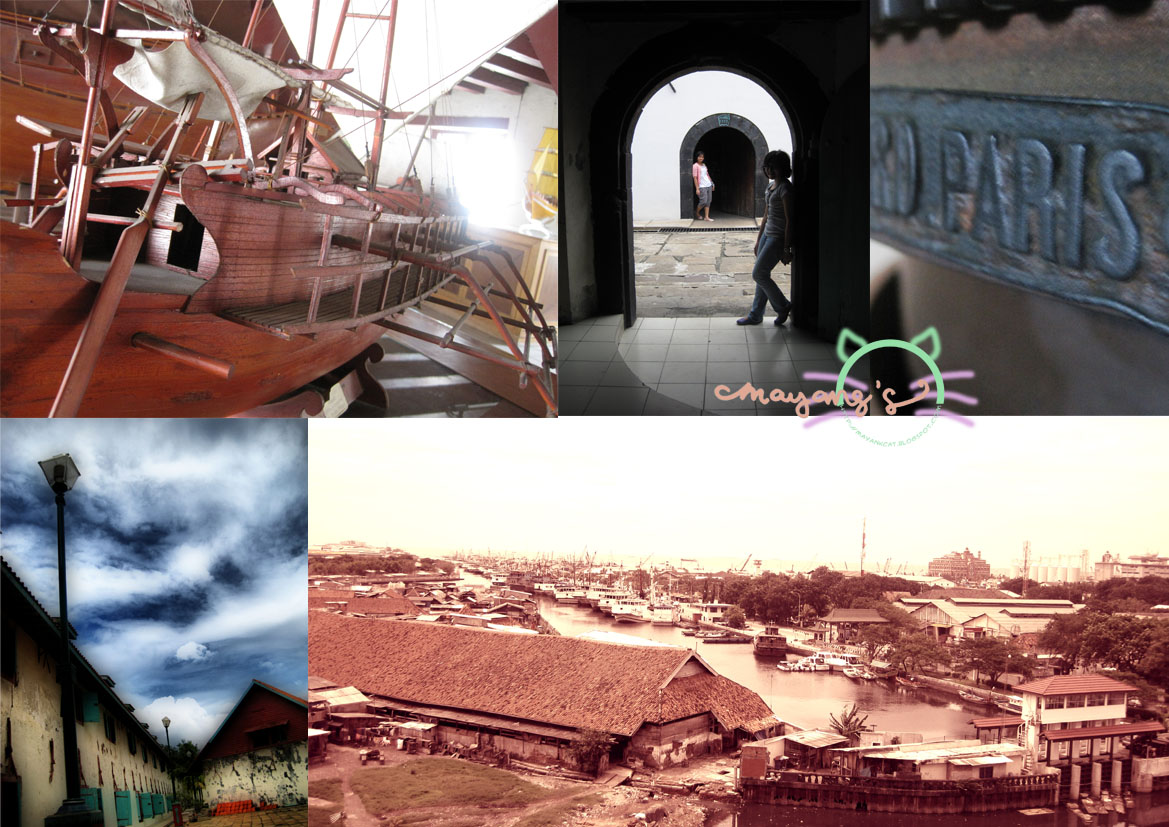
Next stop was the Maritime Museum. Way back when before we were businessman, lawyers, and doctors, Indonesians were known as farmers and most of all sailors. There was a song I've known since kindergarten.
Nenek moyangku seorang pelaut Gemar mengarung luas samudera Menerjang ombak tiada takut Menempuh badai sudah biasa Angin bertiup layar terkembang Ombak berdebur di tepi pantai Pemuda berani bangkit bersama Ke laut kita berama-ramai
A song about our ancestors who were sailors. And which place would be better to get in touch with our inner sailorman rather than to visit a maritime museum located at Jl. Pasar Ikan, North Jakarta, Sunda Kelapa. A port that used to be the window of the world. With a 2000 IDR ticket, you can visit two places, the maritime museum and the Syah Bandar Tower. I like going to places like these, although I may not remember all the details about our maritime history, but it was fun to look at ancient buildings. If walls could talk, there would be more stories to tell.
So we closed the evening by visiting the recently happening ancient landmark in Jakarta, the Fatahillah Square. I remembered going here about 12 years ago *back then I was still in middle school, just got back from MYA, and my family thought it would be fun to visit the Fatahillah Museum*. And you know what, 12 years ago.. this place was STRANDED!! Nobody even cares to visit this place. Nowadays, thanks to this historical community, Fatahillah Square is more like an open public space. There were tons of small cook shops, cafes, and everything. You can find lots of vendors selling es potong/es lilin. There's a group of reog *you know like gypsian* that do a Kuda Lumping show every hour. If you'd like to explore the sceneries around this square you can always rent an onthel bike, complete with the nonik-and-sinyo** hat. And if you're tired, you can rest at the Batavia Cafe, it's a bit pricey but very cozy. I love how they design the interior, plus they have a good&friendly performers that sing old school songs *I mean real old school like from the 50s or 60s*


**this is how they used to call a boy or a girl, that comes from the indo-deutsch heredity.

August 31, 2009

Saving Our Heritage | Ullen Sentalu

6 Comments
A place that has been recommended by a friend of mine to visit, and finally on my last trip to Jogjakarta I decided to spare times to pay this place a visit. Located in Kaliurang, Yogyakarta, this museum shouldn't be hard to find. Just ask your tour guide or the locals they will show you the way to this pretty exotic museum. Ullen Sentalu itself is actually an acronym of "ULating bLENcong SEjatiNe TAtaraning LUmaku" which means that the light of blencong *a lamp that is used in wayang kulit performance* is a guide for humans to run their life. By now you can tell, that yes.. this museum is preserving the Javanese cultural heritage.
Run by a private foundation, you will find this museum very well taken care of. You can't go inside the museum freely and have to wait for the guides to go in there. It is no wonder, because I assume you might get lost if you decided to roam around by yourself as it has mazelike architecture. The Museum is built in accordance with the Kaliurang landscape. That's why you'll find the building antique, exotic, and jungle like at the same time. Well I couldn't explain it any better, and I have no pictures to show you either since it is forbidden to take pictures inside the Museum *we could take pictures in the garden though, and it is just as beautiful*. By the way I think this is a nice place to do a pre-wed photo shoot.
Speaking of the collection, you could actually learn ancient Javanese tradition and way of life. This is shown through series of potraits, sculptures and paintings of the Kraton *Kasultanan, Mangkunegaran, Pakualaman, and Kasunanan* family members. Along with the visit you'll find some detail facts like why the Kraton family members don't wear ring on their middle fingers, or which batik design is used by who and in which occassion, or the symbolic meanings in a bride's makeup *you know like the west culture believe in wearing something old something blue stuff on their wedding day*. At the end of the tour you will be taken to try a traditional jamu recipe*a drink made from spices* that is believed will make you stay young.
For only 25.000 IDR (15.000 IDR for local students) this is the place that worth your visit. Especially with this nationalism sentiment to preserve the Indonesian culture, why not start by visiting this cultural sites and learn more about it. For more information you could visit the Ullen Sentalu official website.

Let's start with something small, and start learning today. If not us, then who else? If not now, then when? ^^
Note: you'll never know what you have until you lose it.

July 04, 2009

Saving Our Heritage | Batik-ing @ Textille Museum

2 Comments
Not many know about the existence of this museum, as it is not as extravagant as the museums on Medan Merdeka Barat Street (The National Monument, National Museum) or have classic architecture as the museums located in Jakarta's Kota Tua. But still, if you have a lot of free time, and are that artsy craftsy kind of people, then the Textille Museum is a perfect place to visit.
They have a collection of textilles from across Indonesia but mostly are Batik with various styles (Cirebonan and Jogjakarta). To tell you the truth, for me, the collections of Textille Museum are a bit mediocre *or maybe I'm just not that good with textille*. Well, maybe it's because the museum is not well maintain, a bit dusty and gloomy. If only they add more collections and make it more interactive, the place will be more attractive to visit.
Anyway, my main reason to visit this museum is not only to see the collections, but to join the batik workshop. It is held everyday but Monday *as the museum itself is closed on Monday*, from 9AM to 1PM *as the museum will close at 3PM, and it took about 2 hours to get the job done*. The workshop is not like a formal class. Just come between those hours, then you will get a piece of white cloth ready to be Batik-ed. The instructors are not going to watch closely on how you are doing your work, they just give brief instructions and let you do the rest. Okay so this is a step-by-step recap on how to make Batik.

  1. Prepare a piece of cloth
  2. First pick any kind and size of cloth you want. Since it is such a sparing package workshop, I only got a 35cmx35cm white cotton fabric. In real batik making process, you could actually color the cloth first, if you want another foreground color (instead of white).

  3. Draw a pattern
  4. Next is choosing a pattern design and draw it on the cloth with pencil. This will be the guidelines when you put malam on the next step. The workshop provide a pile of designs you could chose, from classic to modern, from abstract symbols to cartoon characters. One warning from the instructor though, is not to chose a very detail design, since it will take a long time to finish *yeah..we're amateurs, we get it..* and they don't have the canting needed to produce such detail design.

  5. Apply the malam
  6. Happy with your pattern. Next step is applying the malam (wax). The point of doing this is to cover the area that will not be colored or to avoid color mixing, if you're going to use several colors. This is done by using a tool called canting. I used to watch old ladies doing this in batik shop and it seemed so easy. But actually you really need a steady hand to get a fine stroke. You have to do it perfect from point to point the first time. Don't go back and forth, or apply the malam over and over again for the same line, do it one time only and perfectly. If not, you will get wobbly designs like mine. hehe.. Oh yeah.. since it is a handwritten batik, you have to apply malam on the other side of the cloth as well (mirror way). *kinda remember what my father did to distinguish a handwritten batik from the stamping and printing kind, he checked both sides of the cloth, but don't ask me why..*

  7. Coloring
  8. Okay..so the next step is coloring. In this workshop we only got to do one color. Before we put the cloth in the coloring bucket, the man (in charge of the dyeing process) applied paraffin on the sides of the cloth, this was done to create a frame kind effect to the cloth.

  9. Remove malam
  10. Last but not least is removing the malam. In order to do this, you have to boil the cloth in water so the malam melt away from the cloth. After that hang the cloth and let it dry.
Tada!! This is us with our work of arts..

Some additional infos, this museum is located in Jl. K.S. Tubun No. 2-4, near the Tanah Abang Market, Jakarta. Had more questions about the workshop package and others? you could dial (021)5606613. By the way the workshop I took was the most economic one for IDR 35.000, including a ticket to the museum.
For more information on batik processes and designs you could visit this site. I find it very informative and thorough. sengihnampakgigi

May 23, 2009

Saving our heritage | trips to the banking museum

4 Comments
Hari yang sungguh melelahkan, hanya secara fisik tidak secara psikis. Setelah seharian berjalan-jalan, saya pulang dengan betis yang berdenyut-denyut serasa membengkak, tapi dengan otak yang begitu fresh. Oke, jadi hari ini memang telah direncanakan oleh saya untuk berjalan-jalan keliling kota tua. Intinya jalan-jalan untuk keluar masuk museum, menikmati pemandangan, menambah informasi, dan pastinya foto2 aksi. hahaha..
Namun karena jadwal yang terlalu padat, tidak dapat dihindari, saya hanya dapat mengunjungi Museum Bank Mandiri dan Museum BI *padahal niat awalnya mampir ke Fatahillah dan Wayang juga*. Walaupun begitu, saya sangat menikmati mengunjungi kedua museum tersebut. Terutama Museum Bank Mandiri. Tidak dapat dibayangkan bahwa gedung yang sudah berdiri lama ini merupakan saksi sejarah perbankan Indonesia.
Dan begitu memasukinya saya langsung tahu kenapa buku besar yang merupakan buku utama pencatatan transaksi keuangan itu dinamakan "Buku Besar". Ya karena memang bentuknya yang super duper besar. hoho..
Menarik berjalan2 di dalam Museum Bank Mandiri. Selain menikmati arsitektur gedung yang oh-so-old-and-antique itu, saya juga sedikit berimajinasi tentang bagaimana kegiatan perbankan dijalankan dahulunya, dan bagaimana penyediaan servis dari perbankan itu berevolusi *mengingat saya berjalan2 dengan pegawai BRI+BCA+Niaga, mau tak mau saya sedikit menguping tentang ini-itu-nya dunia perbankan*
Museum BI, menawarkan pengalaman yang berbeda dari Museum Bank Mandiri. Karena lebih interaktif dan mengekspos fun facts tentang dunia perbankan. Contohnya asal muasal kata "bank" dan "duit". Selain itu juga ada pemutaran film mengenai dunia perbankan, keuangan, dan ekonomi, seperti inflasi, cara pencetakan&peredaran uang, sejarah BI, dll. Pas kesana sih, saya paling heboh di ruang..mm..apa ya namanya?? saya lupa. tapi yang pasti ruang ini gelap terus ada tembok yang dijadikan sebagai layar proyektor. Nah di tembok tersebut ada uang-uang koin digital berterbangan yang bisa kita tangkap. Kalo berhasil ditangkap, akan keluar informasi mengenai uang tersebut, contoh: nominal pecahan uang tersebut, dikeluarkan tahun berapa, dll. Saking semangatnya menangkap koin-koin receh digital ini, saya sampai gedebak gedebuk meraba2 tembok. Sampai akhirnya penjaganya bilang "Temboknya jangan disentuh ya..". Oops..sengihnampakgigi
Satu lagi tempat yang menarik adalah ruang numimastik *bener gak sebutnya??*. Di sini ada koleksi uang-uang Indonesia dari jaman dulu sampe sekarang. Dan uang-uang yang hanya dicetak untuk kepentingan koleksi. I am not a money collector, but I really do enjoy looking at those sometimes bizarre coins and money. Koin disamping merupakan salah satu contoh koin edisi khusus "For The Children of The World". Nice..
Setelah puas mengunjungi museum2 tersebut, agenda saya pun dilanjutkan dengan menonton A Night At The Museum 2, yang mem-fitur The Smithsonian Museum. And I am just wowed looking at that world's largest museum complex. Looks like it's going to be on my places-to-visit list. Hanya bisa menerawang, kapan Indonesia punya komplek museum seperti itu *tampaknya Kota Tua bisa dikembangkan, asal tertata dengan sangat baik*. Begitu pulang langsung saya googling, dan hasilnya bisa membuat saya ternganga lebar. Bisa dibilang The Smithsonian merupakan museum yang komplit, mulai dari art, culture, nature, social, architecture, history, science&tech bahkan sampai ada zoological park segala. Yang bikin saya menganga lagi, kompleks yang terbilang komplit ini pun bermimpi untuk menambahkan koleksi mereka *terbukti dengan akan dibangunnya museum mengenai budaya dan sejarah african-american*. I really do wish we have something like that here. Something that reminds us of where this root really belongs to. I may not be a really big fan of history, I don't even remember much about those war dates, or the chronography of important events. But I wouldn't mind having the history preserve in a museum, just so people like me could always go there and get a blast from the past. Seriously, I believe learning history would be a lot easier when it's more of a story telling and less of forcing students to remember specific dates and names.
jasmerah ~ jangan sekali-kali melupakan sejarah..


Fioritura Fiori Copyright © 2012 Design by Ipietoon Blogger Template